00Abstract
the universal shitcoin is a meme token you can own in part. Its flesh has been partitioned into 1,000,000 pieces. To hold a piece is to hold a literal percentage of the coin.
The system is built around one honest loop: activity creates fees, fees fund buybacks, buybacks remove supply and lift the price. There is no team allocation. Every incentive points the same direction: up.
01The Coin
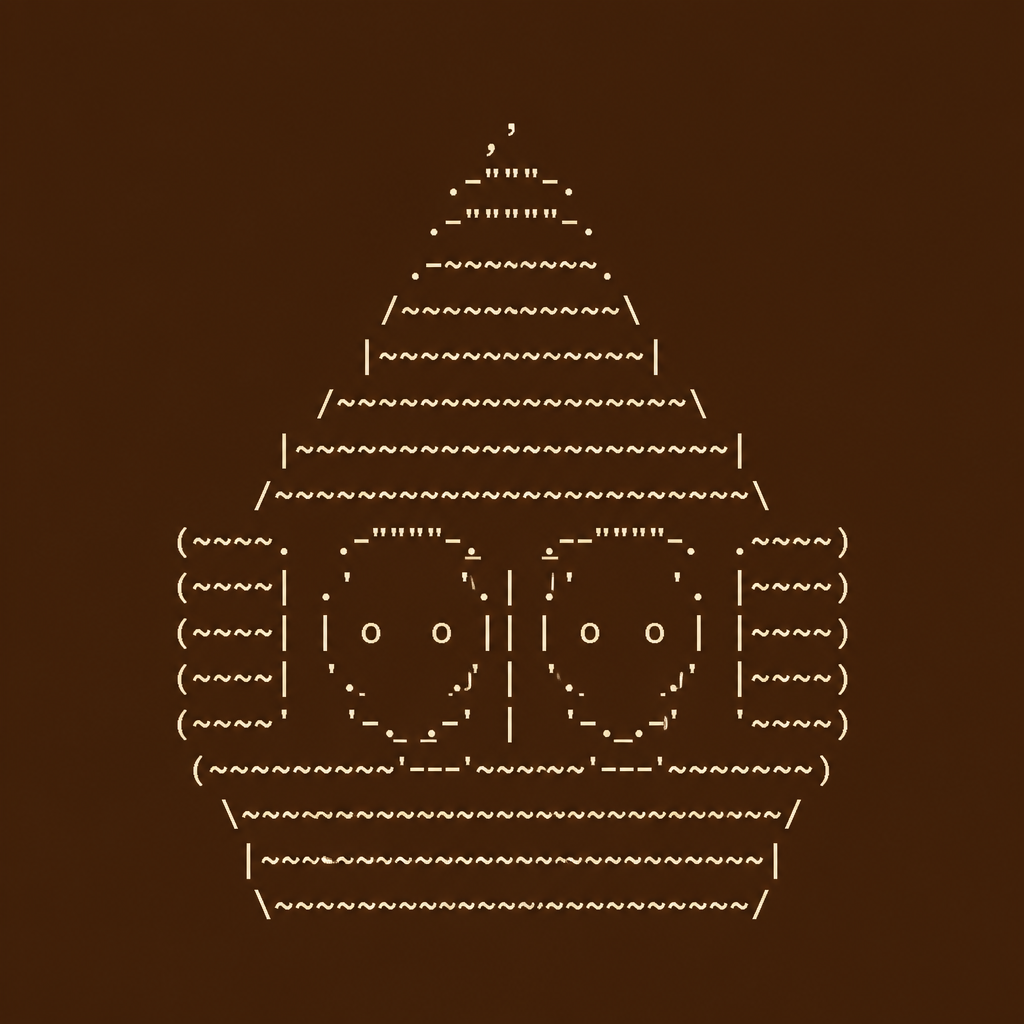
the universal shitcoin is not a mascot bolted onto a token. The swirl on screen is the token. When you look at the app, the body floating at the center is the asset itself, glowing brighter or dimmer with the market.
Two organs keep it alive:
- The Body — a fixed supply of 1,000,000 pieces, drawn as an interactive map fenced into exactly 100 claimable plots (see The Last Land). This never inflates. The coin cannot be diluted; it can only change hands.
- The Gut (Treasury) — the metabolic core. It digests every fee the system produces and converts it into buybacks.
The market keeps moving whether or not you are watching. Other wallets mint and trade, the treasury fills and fires on its own. You are joining something already in motion.
02Ownership & the % Model
Ownership is deliberately concrete. The coin is 1,000,000 pieces and not one more. If you hold 10,000 pieces, you own exactly 1.000% of the universal shitcoin. If you hold 250,000, you own a quarter of it. Those pieces are parceled across exactly 100 plots — the whole body, and the last land it will ever sell (see The Last Land).
What owning a piece means
- Proportional exposure. Your share of the market cap is your share of the body — no more, no less.
- Transferability. Pieces are freely tradeable. Mint them, claim a plot, hold them, or list them for others.
- Alignment. Because buybacks lift the price of every piece equally, the treasury works for you the moment you hold anything at all.
your pieces ÷ 1,000,000 × 100. Simple, fixed, and impossible to inflate away.03The Last Land — Claiming Plots
At the center of the app, the coin's body is drawn as one big interactive map — surveyed and fenced into exactly 100 plots. Every plot is clickable, and together the hundred of them are the universal shitcoin: 100 plots = 100% of the coin. There is no other primary supply, no reserve held back, no sequel drop. This is the last land it will ever sell.
Finality is the whole point. Once a plot is claimed it leaves the map for good, and the only way anyone else gets it is to buy it from its owner. When the map fills, primary issuance is over forever — a fixed, fully-settled territory, and the only frontier left is the secondary market.
Plots, area & your stake
Plots are not uniform — they vary in size. A plot's weight is simply how much of the body it covers:
plot area (glyph count) ÷ total body glyphs × 100, and pieces = 1,000,000 × stake% ÷ 100. A bigger patch is a bigger share of the coin.Because every plot's stake is carved from the same body, all 100 plots sum to exactly 100% and exactly the full 1,000,000 pieces. Claiming a large plot moves your ownership percentage more than claiming a small one — the map lets you choose how much you want, not merely whether you're in.
Reading the map
Every plot wears its status openly, so the map doubles as a live ownership board:
| Plot state | Appearance | What it means |
|---|---|---|
| Unclaimed | Dim | Owned by no one yet — available to buy |
| Claimed by others | Amber | Held by another wallet; only they can sell it |
| Claimed by you | Bright, glowing | Yours — counted in your ownership % |
Hover any plot for a quick tooltip — its plot number, area, price, and the price impact claiming it would have. Click a plot to open its full details panel on the right.
The plot panel
Clicking a plot slides out a details panel laying out everything you need before you commit:
- Price (ETH) — what this exact plot costs to claim right now.
- Ownership % — the stake this plot represents in the coin.
- Area / cells — how many glyphs of the body it spans.
- Plots claimed — the running
X / 100across the whole map. - Current impact — how much this purchase nudges the price.
- Status — unclaimed, yours, or held by another wallet.
- A BUY FOR Y ETH button that claims the plot outright.
Claiming a plot
Hitting BUY on an unclaimed plot settles it in a single motion:
You pay the plot's price, a standard 4% fee is routed 100% to the treasury, and the plot's full allocation of pieces is minted straight to your wallet — lifting your ownership percentage by exactly that plot's stake. The plot flips to bright, glowing yours, the X / 100 counter ticks up, and the map lights a little further toward full settlement. The same fee that buys you land also feeds the buyback engine described in Treasury & Buyback.
04Minting & the Curve
Pieces enter circulation through minting. You exchange ETH for freshly minted pieces drawn from the unminted reserve. Minting is how you get your first slice, and it is priced on a bonding curve: the more that has been minted, the more each remaining piece costs.
The price function
The live floor price is derived transparently from two inputs — how much has been minted, and how much the treasury has bought back:
price = BASE × ( 1 + minted/SUPPLY × 6 + boughtBack/SUPPLY × 34 )Two things fall out of this design. First, early minters pay less per piece than late minters — the curve rewards conviction. Second, buybacks are weighted far more heavily than raw minting (a factor of 34 versus 6), so the treasury's activity is the dominant force on price over time.
Fees on mint
Every mint carries a 4% fee, routed in full to the treasury. You are, in effect, funding the buyback that supports the very pieces you just minted.
- You choose an amount of ETH to spend.
- 4% is skimmed to the treasury; the remainder buys pieces at the current price.
- Your ownership percentage updates instantly.
05The Marketplace
Once you own pieces, you are free to put them up for sale. The marketplace is peer-to-peer: you set the quantity and the price per piece, and your listing sits alongside everyone else's. Buyers take the best price they can find, which establishes the floor.
Listing your pieces
- Choose how many pieces to list and your asking price per piece.
- Listed pieces are escrowed out of your holdings until they sell or you cancel.
- Cancel any time to return pieces to your wallet.
Buying from others
Buying a listing transfers its pieces to you instantly. As with minting, a 4% fee on every marketplace trade is routed to the treasury — meaning secondary trading is itself a buyback fuel source.
06Treasury & Buyback
This is the heart of the token. The treasury is a perpetual buyback engine with a single, non-negotiable rule:
The loop
Why buybacks push price up
Each buyback does two things at once. It applies real buy pressure on the open market, and it permanently removes those pieces from circulation. In the price function, bought-back supply is weighted at 34× — so every buyback ratchets the floor upward and, unlike ordinary demand, it never sells back.
Automatic and manual
- Automatic: once the treasury accumulates enough fees, it fires a buyback on its own, day and night.
- Manual: anyone can open the Treasury panel and Trigger buyback now, spending 100% of the current balance immediately.
The Treasury panel shows the live loop end to end: fees collected, current balance, total spent on buybacks, pieces removed, number of buybacks executed, and the cumulative price impact since genesis.
07The Happiness Engine
Happiness is denominated in price. The happiness score (0–100) is derived from how far the price has climbed above genesis, plus short-term momentum that spikes whenever a buyback lands.
happiness = 34 + priceGain × 9 + buybackMomentum × 20, clamped to 0–100.Moods
| Score | Mood | What you'll see |
|---|---|---|
| 82–100 | ECSTATIC | green glow |
| 62–81 | HAPPY | warm gold glow |
| 42–61 | CONTENT | steady amber |
| 22–41 | GLUM | dimmed |
| 0–21 | MISERABLE | red glow |
Mood changes the map's glow. A well-fed treasury lights the coin up; a dump dims it.
08Tokenomics
| Parameter | Value |
|---|---|
| Ticker | $SHIT |
| Total supply (fixed) | 1,000,000 pieces |
| Genesis price / piece | 0.0000015 ETH |
| Mint fee | 4% |
| Marketplace fee | 4% |
| Fees to treasury | 100% |
| Fees to buyback | 100% |
| Team / insider allocation | 0% |
There is no emission schedule, no vesting cliff, and no inflation. Supply only ever moves in one direction relative to the float: out of circulation, via buyback. Distribution happens entirely through open minting and secondary trading, on the same terms for everyone.
09Roadmap
- Phase I — Genesis. Minting opens, the marketplace goes live, and the treasury begins its first buyback cycles.
- Phase II — Metabolism. Deeper treasury analytics and a public buyback ledger.
- Phase III — Market. Stronger liquidity and holder-driven treasury cadence.
Roadmaps are intentions, not promises.
10FAQ
11Glossary
Piece — one of the 1,000,000 indivisible units that make up the coin; the thing you own and trade.
Bonding curve — the pricing rule where each newly minted piece costs slightly more than the last.
Floor — the lowest price the coin is currently available for, set by the cheapest active listing.
Treasury — the on-system wallet that collects fees and executes buybacks.
Buyback — a treasury purchase that removes pieces from circulation and pushes price up.
Happiness — a 0–100 mood score, derived from price and buyback momentum.
Momentum — a short-lived boost to happiness that spikes on each buyback and decays over time.
12Risks & Disclaimers
This is a meme and an experiment. This documentation describes a playful, self-contained simulation. The current app runs entirely in your browser: balances, mints, trades, and buybacks are simulated locally and no real funds move.
Not financial advice. Nothing here is an offer, solicitation, or recommendation to buy or sell anything. Crypto assets are volatile and can go to zero. Never risk more than you can afford to lose, and always do your own research.
By using the universal shitcoin you acknowledge that it is provided "as is," without warranties of any kind, and that you alone are responsible for your decisions. It is not your financial advisor.